When Will My Blog Rank in Google?
Most new blogs start seeing measurable organic traffic between months 3 and 6, but ranking for competitive keywords can take 12 months or longer. The timeline depends heavily on your niche competition, publishing cadence, and whether Google has indexed and trusted your site yet. Knowing what to expe
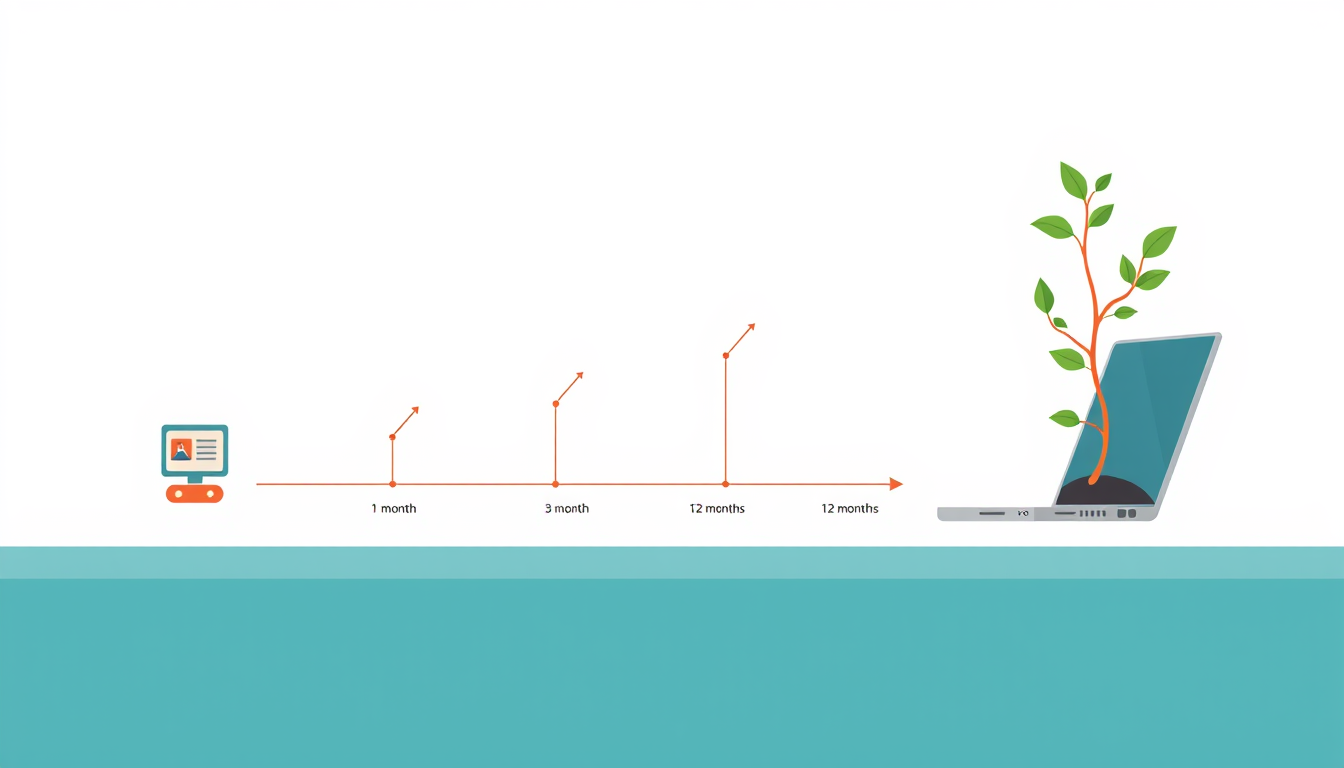
Most new blogs take 3 to 6 months to see meaningful organic traffic, and 6 to 12 months to rank competitively for target keywords. This isn't a flaw in your strategy — it's Google's trust-building process at work. Publish consistently, target low-competition keywords early, and the compounding effect kicks in around month four.
The Real SEO Timeline for New Blogs: What the Data Actually Shows
Ahrefs studied over 2 million pages and found that fewer than 6% of newly published pages rank in the top 10 within a year. The pages that do rank fastest share two traits: they target low-difficulty keywords (under 20 KD in Ahrefs terms) and they come from domains with some existing authority. For a brand-new blog with zero backlinks and a fresh domain, here's what realistic looks like: Months 1–2 are almost entirely invisible. Google crawls your site, but trust is near zero. Month 3 is when impressions start appearing in Google Search Console — you're showing up in searches, just not on page one yet. Months 4–6 is when clicks begin if your keyword targeting is tight. You'll rank on page two or three for long-tail queries. Months 6–12 is when compounding starts. Older posts climb, internal links pass authority, and you start landing page-one spots for lower-competition terms. The key insight: SEO results aren't linear — they're exponential. The first three months feel like nothing, then growth accelerates sharply if you've built the foundation correctly.
How to Accelerate Your SEO Timeline Without Shortcuts
You can't skip Google's trust-building process, but you can work with it smarter. First, target keywords with a Keyword Difficulty below 20 using Ahrefs or Semrush. New blogs have no business going after 'best project management software' — write about 'best project management software for solo consultants' instead. Second, publish at minimum two posts per week for the first three months. Volume signals activity to Google and builds your topical authority faster. Third, interlink aggressively from day one. When you publish post 10, link back to posts 1 through 9 where relevant. This passes crawl equity and keeps new content from sitting in isolation. Fourth, submit your sitemap via Google Search Console immediately after launch and use the URL Inspection tool to request indexing for every new post. Don't wait for Google to find you passively. Fifth, get at least one or two genuine backlinks in your first 60 days — even from directories or niche communities like Reddit or industry forums. A single relevant link from a real site cuts months off your indexing delay. These five steps alone will push your first traffic results from month six closer to month three.
The Mistakes That Silently Kill Your SEO Timeline
The biggest mistake new bloggers make is publishing high-competition content too early. Writing about 'how to lose weight fast' on a three-month-old blog wastes months of effort. Track your Keyword Difficulty scores before every post — if it's above 30 and your domain rating is under 10, skip it for now. Second mistake: not tracking the right metrics. Forget traffic for the first 90 days. Instead, open Google Search Console weekly and watch impressions. Impressions growing means Google is reading and categorizing your content correctly. Zero impressions after 60 days means an indexing problem you need to fix immediately. Third mistake: inconsistent publishing. Posting 10 articles in week one then disappearing for a month trains Google to deprioritize your crawl schedule. Consistency beats volume. Four posts a month published reliably outperforms 20 posts dumped in a sprint. Finally, ignoring search intent kills rankings even for well-optimized posts. If you write a listicle for a query where Google only ranks how-to guides, you won't rank regardless of your keyword density. Use Semrush's SERP analysis or simply Google your target keyword and reverse-engineer the format of the top three results before you write a single word.
Key Takeaways
- New blogs typically see their first organic clicks between months 3 and 6, not weeks.
- Target keywords with a Difficulty score under 20 in Ahrefs or Semrush for the fastest early wins.
- Track impressions in Google Search Console first — clicks follow impressions, not the other way around.
- Consistent publishing (even two posts per week) compounds faster than irregular high-volume sprints.
- One or two genuine backlinks in your first 60 days can cut months off your indexing and ranking timeline.
FAQ
Q: Can a new blog rank on page one within 30 days?
A: Yes, but only for near-zero-competition keywords with very low search volume — think hyper-specific long-tail queries with fewer than 100 monthly searches. For anything with real traffic potential, 30-day page-one rankings on a new domain are statistically rare and not worth building your strategy around.
Q: Does publishing more content always speed up SEO results?
A: Only if the content is well-targeted and indexed properly — publishing 50 low-quality posts that Google ignores does nothing. Focus on topical depth over raw volume: cover one subject area thoroughly before branching out, which builds the topical authority Google rewards.
Q: What if my traffic is still flat after 6 months?
A: Run a site audit in Screaming Frog or Semrush to check for indexing errors, thin content, or keyword cannibalization first. If the technical foundation is clean, the likely culprit is keyword difficulty — pull your target keywords in Ahrefs and shift your focus to anything with a KD under 15.
Conclusion
SEO for new blogs is a 3-to-12-month game depending on your niche, consistency, and keyword strategy — but it's entirely predictable once you understand the stages. Stop measuring success by traffic in month one and start measuring by impressions and indexed pages. Your single most important next step today: open Google Search Console, confirm your sitemap is submitted, and identify the three lowest-difficulty keywords in your niche to target in your next posts.
Related Posts
- How Do Bloggers Rank in 2026? The Complete SEO Guide
SEO for bloggers in 2026 demands topical authority, structured content that AI engines can parse, and flawless technical foundations. This guide gives you the exact playbook—keyword research through link building—so you rank in both traditional and AI-powered search. - How Long Before a New Blog Gets Google Traffic?
Most new blogs won't see meaningful organic traffic for 6–12 months—and that's normal, not failure. Google needs time to crawl, index, and trust your domain. But the actions you take in months 1–3 directly determine whether you break out at month 6 or stay stuck at zero. - How Does E-E-A-T Impact Your Google Rankings?
E-E-A-T stands for Experience, Expertise, Authoritativeness, and Trustworthiness — the four signals Google uses to decide if your content deserves to rank. It's not a direct algorithm score, but it shapes how quality raters and Google's systems evaluate your site. Blogs that visibly demonstrate real